



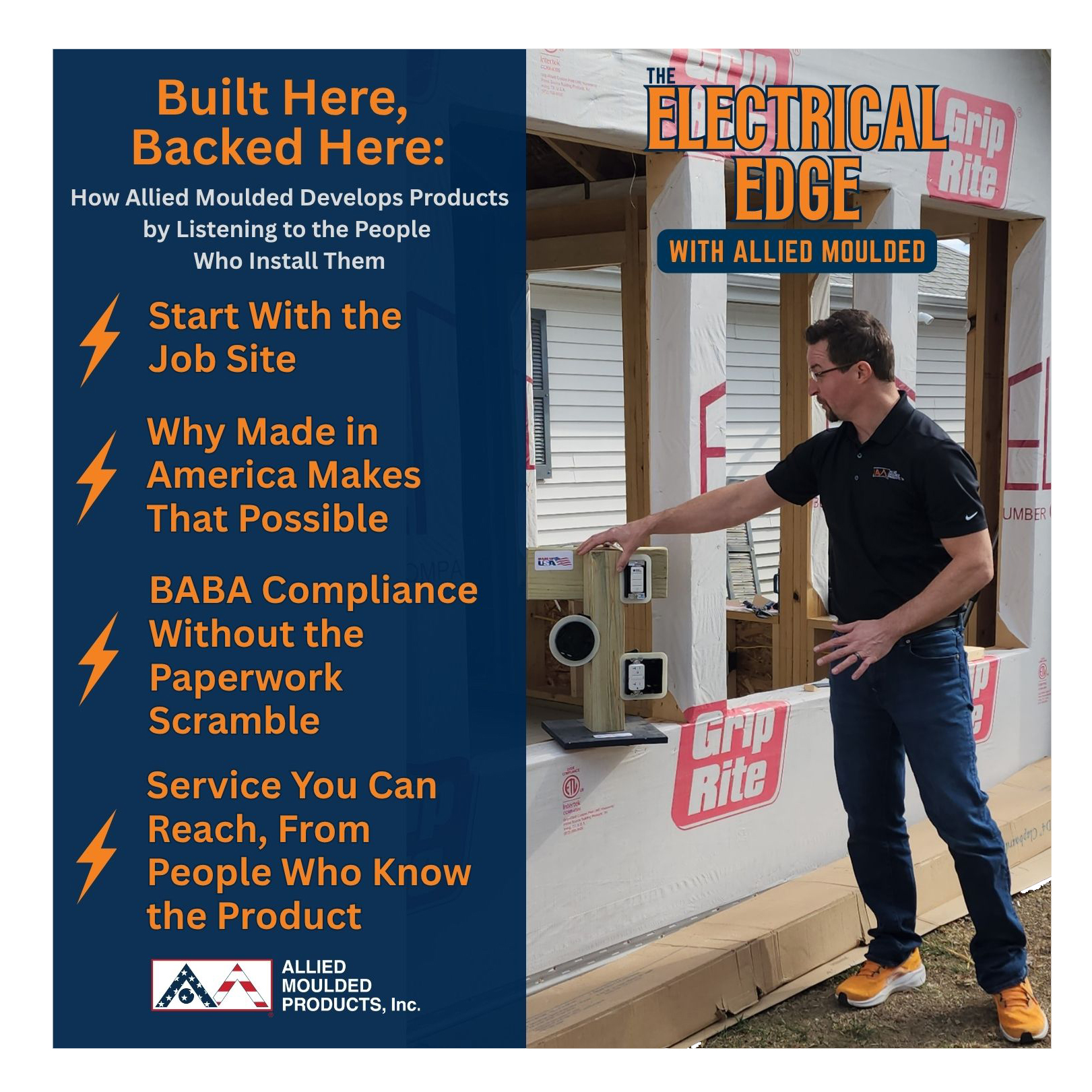
Most product development starts in a conference room. At Allied Moulded, it increasingly starts on a job site, talking to the electrician who will actually install the box. And everything that follows, from the engineering to the tooling to the finished product, happens under one roof in the United States.
Start With the Job Site
Allied’s team has made a deliberate shift: instead of assuming it knows what the market needs, it goes and asks. Product, sales, and leadership travel from California to the Carolinas to sit down with contractors, electricians, and inspectors and put one question to them: what’s missing?
The answers are specific. Contractors say what they don’t like about competing products, which jobs leave them carrying extra box types, and where their current options fall short. One frustration comes up again and again: nobody wants to dig through a truck full of different cartons from different manufacturers just to cover a single house. They want one source, with the same features across the line, so they aren’t relearning a new box every time the spec changes.
That feedback is shaping how Allied rounds out its portfolio. The goal is a lineup contractors can reach for on any job, with nothing extra to learn.
Why Made in America Makes That Possible
Field feedback only matters if a manufacturer can act on it quickly. Allied can, because the whole chain sits in one place. The company runs its own R&D and engineering, and its own tooling department builds its own molds. An idea from a job-site conversation can move from concept to engineering to a finished product without waiting on an overseas supplier or a handoff three steps removed from the customer.
Allied’s team describes that process as noticeably faster than it was even a few years ago, and they have more in the pipeline that they expect to move quicker still.
That vertical integration extends well beyond the boxes. Allied works to make as much of what an installer sees in and around the box as possible in-house, so the supply chain is short and every step of it is visible.
BABA Compliance Without the Paperwork Scramble
For projects with Build America, Buy America requirements, that matters. Many manufacturers have to piece together domestic content from a mix of suppliers and then document it. Allied’s position is simpler: the product is made in the USA, in a small-town American facility, with the materials and manufacturing kept here.
For a contractor or specifier, that means the question of whether a box meets a domestic-sourcing requirement has a short answer. When a job calls for BABA-compliant product, Allied is built to satisfy it, with nothing to chase down across a global supply chain.
Service You Can Reach, From People Who Know the Product
American-made also means the people behind the product are accessible. The same team that develops the boxes is the team out on job sites, in front of contractors and inspectors. When an installer has a question, the answer comes from people who work with the product every day.
That depth shows up inside the company too. Allied’s Quarter Century Club recognizes employees with 25 years or more of service, and some of its members have been there for four decades or longer, with at least one recently marking fifty years. Contractors who call with a question are talking to a team with a long memory for this product and a stake in getting it right. Allied’s people describe the team as family, and that sense of ownership carries over to the customers they serve.
The Bigger Idea
None of this is about a single product. Allied listens in the field, designs and tools its products in-house, makes them in America, and stands behind them with a team that knows them. Each of those supports the others: listening is faster because the factory is close, exceptional quality holds because the process is controlled, and service is better because the people are the same ones who built the product.
The result is a product line shaped by what contractors are asking for, made by people who live and work where the product is made.
