



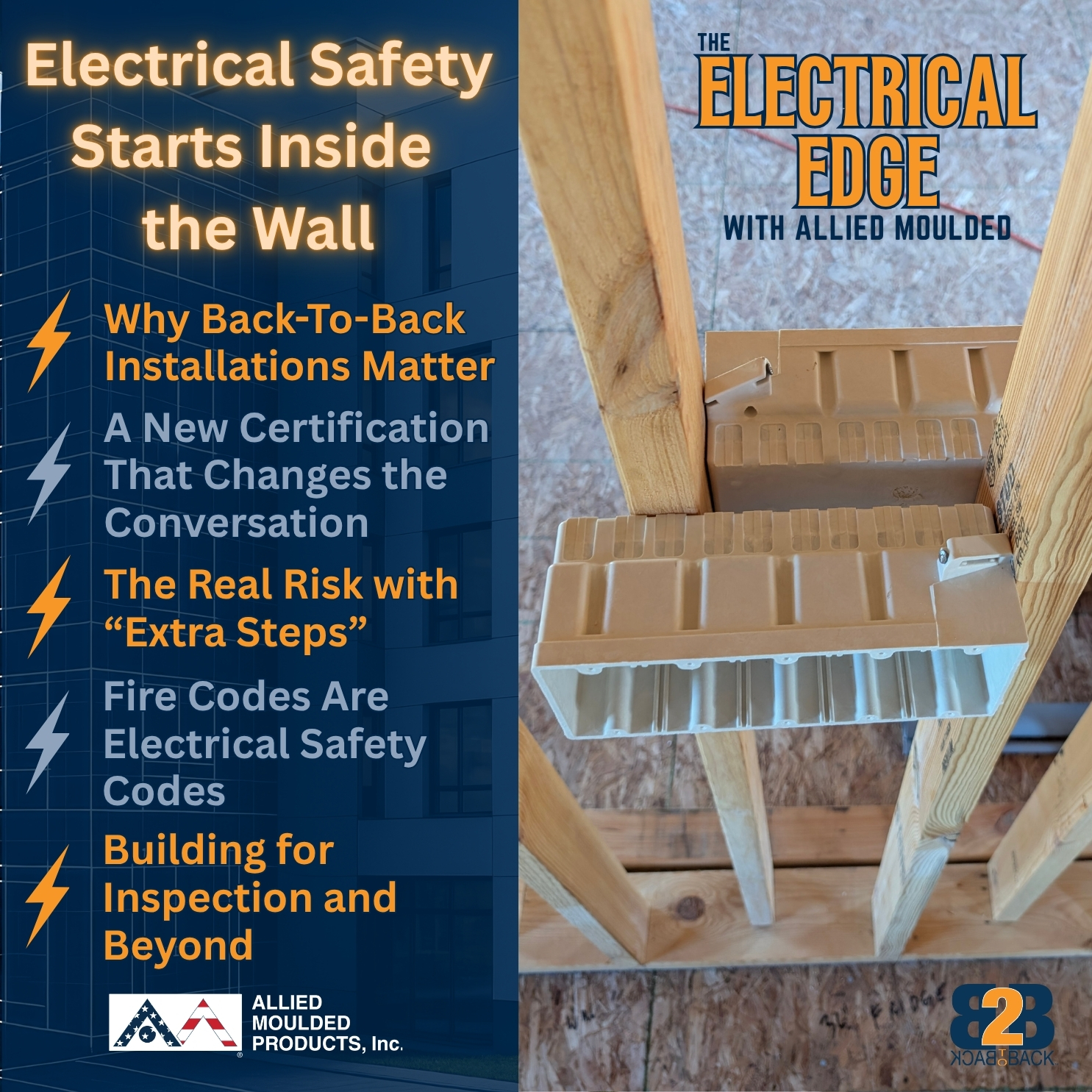
When people talk about electrical safety in residential construction, the conversation usually centers around breakers, grounding, or overloaded circuits. Those systems matter tremendously. But many of the most important electrical safety decisions in a building happen much earlier: during rough-in, long before a device is energized or a panel is commissioned.
They happen inside the wall itself.
In modern residential and multi-family construction, electrical boxes are more than simple connection points. They become part of the building envelope, part of the fire-rated assembly, and part of the long-term safety performance of the structure. If those installations are poorly executed—or if products are chosen without considering how they interact with fire codes and inspection requirements—the consequences can extend far beyond a failed inspection.
That’s especially true in multi-family construction, where fire-rated wall assemblies are designed to slow the spread of smoke and flame between units. In these projects, even small penetrations matter.
And electrical boxes are one of the most common penetrations in the entire building.
Why Back-to-Back Installations Matter
One of the least understood details in residential electrical safety is the role back-to-back electrical boxes can play in a fire-rated wall assembly.
In apartments, condos, student housing, hotels, assisted living facilities, and mixed-use developments, shared walls are often required to maintain a one-hour or two-hour fire rating. These assemblies are engineered specifically to slow the spread of smoke and flame from one unit to another, giving occupants more time to evacuate safely during an emergency.
But every penetration in those walls introduces risk.
Back-to-back installations occur when electrical boxes are mounted directly opposite one another within the same stud cavity. Historically, that arrangement has raised concerns because it reduces the amount of material separating the two sides of the wall. Too many penetrations—or improperly protected penetrations—can compromise the integrity of the assembly itself.
For years, many contractors approached back-to-back installations cautiously or avoided them altogether because of the extra labor and inspection complexity involved. Others relied on field-applied solutions like putty pads to maintain compliance.
But many people in the industry still don’t realize that certified back-to-back solutions now exist that simplify this process significantly.
A New Certification That Changes the Conversation
Allied Moulded’s fiberglassBOX™ line is now UL-certified for back-to-back installation in a minimal 5½-inch wall stud cavity with a two-hour fire rating—without requiring putty pads.
That distinction matters.
Not requiring putty pads changes the installation process in a very practical way. Contractors no longer need to add additional field-applied fire protection materials around the box installation to maintain the rating. That means:
- fewer installation steps
- less labor
- fewer opportunities for inconsistency
- faster inspections
- reduced material costs
And because the certification applies to both existing inventory and new purchases, contractors can immediately begin using products already on hand without waiting for special orders or product transitions.
For crews working on large-scale multi-family builds where hundreds or even thousands of boxes may be installed, those efficiencies compound quickly.
The Real Risk With “Extra Steps”
Every additional step added to a field installation creates another opportunity for inconsistency.
That’s especially true on fast-moving residential projects where multiple crews are working simultaneously under tight deadlines. One installer may apply a putty pad perfectly. Another may rush the process at the end of a long shift. Adhesion may vary. Coverage may vary. Inspections become more subjective because inspectors are evaluating workmanship in addition to product compliance.
The issue isn’t simply labor time—it’s variability.
Simpler systems tend to produce more repeatable results.
That’s one reason certified back-to-back solutions are becoming increasingly attractive to contractors, inspectors, and developers alike. By eliminating unnecessary field-applied materials, installations become cleaner and more standardized across the project.
And when inspection day arrives, that consistency matters.
Fire Codes Are Electrical Safety Codes
It’s easy to think about fire ratings as a drywall or framing issue rather than an electrical one. But in reality, electrical penetrations are deeply connected to the overall life safety performance of a building.
Electrical safety isn’t just about preventing shorts or overloads. It’s also about preserving the integrity of the assemblies surrounding energized systems.
A compromised wall assembly can allow heat, smoke, and flame to spread more rapidly between units during a fire event. That’s why code requirements around penetrations exist in the first place.
And that’s why properly tested and listed products matter so much.
Listings are not simply paperwork exercises. They are designed to verify that products will perform consistently under real-world conditions when installed according to their tested configuration.
For contractors, that translates into confidence:
- confidence during rough-in
- confidence during inspection
- confidence that the installation will continue performing years after occupancy
Building for Inspection and Beyond
Passing inspection is important. But the best installations are designed not just to pass on inspection day, but to perform reliably for the life of the building.
That means thinking carefully about the systems hidden behind the drywall:
- the fire-rated assemblies
- the penetrations
- the box placements
- the long-term integrity of the installation
Modern residential construction moves quickly. Labor shortages, compressed schedules, and increasingly demanding code requirements leave very little room for avoidable rework or inspection delays.
Products that simplify compliance help crews stay productive while reducing uncertainty in the field.
That’s the larger significance of certified back-to-back solutions. They simplify one of the most commonly misunderstood areas of residential electrical installation while helping preserve the integrity of the wall assembly itself.
The Bottom Line
Electrical safety begins long before power reaches the panel.
It starts inside the wall, where fire-rated assemblies, penetrations, and electrical box installations quietly shape the long-term safety performance of the building.
And in multi-family construction especially, even small installation details can have outsized consequences.
That’s why certified back-to-back solutions matter. They help contractors simplify installs, reduce labor, eliminate unnecessary materials like putty pads, and maintain compliance with confidence.
Because the safest installations are often the ones designed to remove uncertainty from the field altogether.
